
Table of Contents
AI Governance vs Regulatory Compliance: What’s the Difference—and Why You Need Both
AI governance vs regulatory compliance is a practical question every security and product team faces. This guide explains both in plain English and shows how to build one, audit-ready program that lets you innovate safely and ship trusted AI.
- AI governance is how you decide, design, test, and run AI responsibly across its lifecycle.
- Regulatory compliance is how you prove to external parties (auditors, customers, regulators) that you meet required laws and frameworks.
You need both: governance keeps AI safe and useful day-to-day; compliance provides assurance and accountability. At CybertLabs, we call this govern once, enforce everywhere. For most teams, AI governance vs regulatory compliance isn’t either/or—it’s one fabric: govern once, enforce everywhere
AI governance vs regulatory compliance—clear definitions
AI Governance
Your internal operating system for building and running AI safely. It sets decision rights, guardrails, and success metrics across the AI lifecycle—from idea to retirement. Governance covers:
- People & roles: product owner, model owner, AI risk officer, security architect, data steward, incident commander.
- Policies & standards: acceptable use, data handling, evaluation and red-teaming, third-party model use, agent permissions, retention/rollback.
- Lifecycle controls: risk tiering, threat modeling, evaluation gates, change control, monitoring for drift/misuse, incident response, and decommission.
- Metrics: coverage of evaluations, pass rates, MTTD/MTTR for AI issues, model change velocity with safety gates.
Goal: build AI that earns trust—before any audit begins.
Typical artifacts: AI policy, risk-tiering rubric, model cards, evaluation plans/reports, decision logs, access reviews, post-incident reports.
What it’s not: a one-time document dump. Governance is continuous and tied to day-to-day engineering.
Our mapping turns AI governance vs regulatory compliance into a single control matrix you can audit.
Regulatory Compliance
Your external proof that obligations are met—security/privacy laws, contracts, and recognized frameworks (e.g., NIST SP 800-53/171, FedRAMP, ISO/IEC 27001/27701, SOC 2, sector rules like HIPAA/GLBA). Compliance turns internal governance into provable control via:
- Scope & applicability: systems in scope, data types (PII/PHI/PCI), locations, suppliers, and subprocessors.
- Controls & mappings: mapping your safeguards to control catalogs; gap analysis; remediation plans.
- Assurance & attestation: independent tests (pen tests, control testing), auditor letters, certifications, continuous monitoring records.
- Evidence management: SSPs, control matrices, DPIAs/PIAs, vendor risk files, and runtime logs that back every claim.
Goal: credibility with boards, customers, and regulators—audit-ready, always.
What it’s not: design theatre. Without working governance behind it, compliance fails under scrutiny.
If you’re comparing AI governance vs regulatory compliance, start by inventorying models and assigning risk tiers.
Where AI governance starts (and how compliance proves it)
Embed controls through the AI/ML lifecycle so teams move quickly with safety:
- Use-case intake & risk classification
- Why: not all AI is equal. Rank by impact, harm potential, and regulatory exposure.
- Artifacts: intake form, risk tier (e.g., low/med/high), required control set.
- Owners: product + risk.
- Data governance by design
- Why: training, tuning, and prompts can leak or bias outcomes.
- Controls: provenance/lineage, consent/contract checks, minimization, quality scoring, protected-attribute handling, retention.
- Artifacts: data inventory, lineage graph, DSR/DSAR responses where applicable.
- Threat modeling for AI/agents
- Why: new attack classes—prompt injection, data exfil via outputs, model theft, jailbreaks, supply-chain risks.
- Artifacts: abuse case catalog, STRIDE-like model for LLMs/agents, mitigations mapped to controls.
- Evaluation & safety gates
- Why: trust requires tests with pass/fail criteria.
- Controls: robustness (adv examples), red-team scripts, safety evals (toxicity, PII leakage), reproducible benchmarks.
- Artifacts: eval plan, results dashboard, “ship/no-ship” record tied to risk tier.
- Access control for models and agents
- Why: model endpoints and autonomous agents are privileged compute.
- Controls: least privilege, scoped tokens, policy-based agent actions, human-in-the-loop for high-risk steps.
- Artifacts: access reviews, approval logs, agent permission manifests.
- Change control & versioning
- Why: small model changes can shift behavior.
- Controls: semantic versioning, dataset checkpoints, rollback plans, staged rollouts, counterfactual testing.
- Artifacts: change tickets, diff reports, rollback runbooks.
- Runtime monitoring & abuse detection
- Why: models drift; attackers adapt.
- Signals: drift metrics, harmful output flags, data egress anomalies, agent action anomalies.
- Artifacts: alerts, incident tickets, weekly trend reports.
- Incident response for AI
- Why: you need a kill-switch before you need it.
- Controls: containment of endpoints/agents, comms plans, customer notifications, model quarantines, hotfix evals.
- Artifacts: AI-specific IR playbook, post-incident review with corrective actions.
- Third-party & open-model governance
- Why: suppliers and OSS multiply risk.
- Controls: supplier assessments, SBOM/model card intake, license checks, indemnities, sandboxing.
- Artifacts: vendor risk files, acceptance criteria, compensating controls.
- Education & accountability
- Why: governance fails without informed people.
- Controls: role-based training, secure-prompting basics, escalation paths, quarterly drills.
- Artifacts: training records, drill outcomes, updated playbooks.
Result: one control fabric—govern once, enforce everywhere—that keeps innovation bold and exposure low.
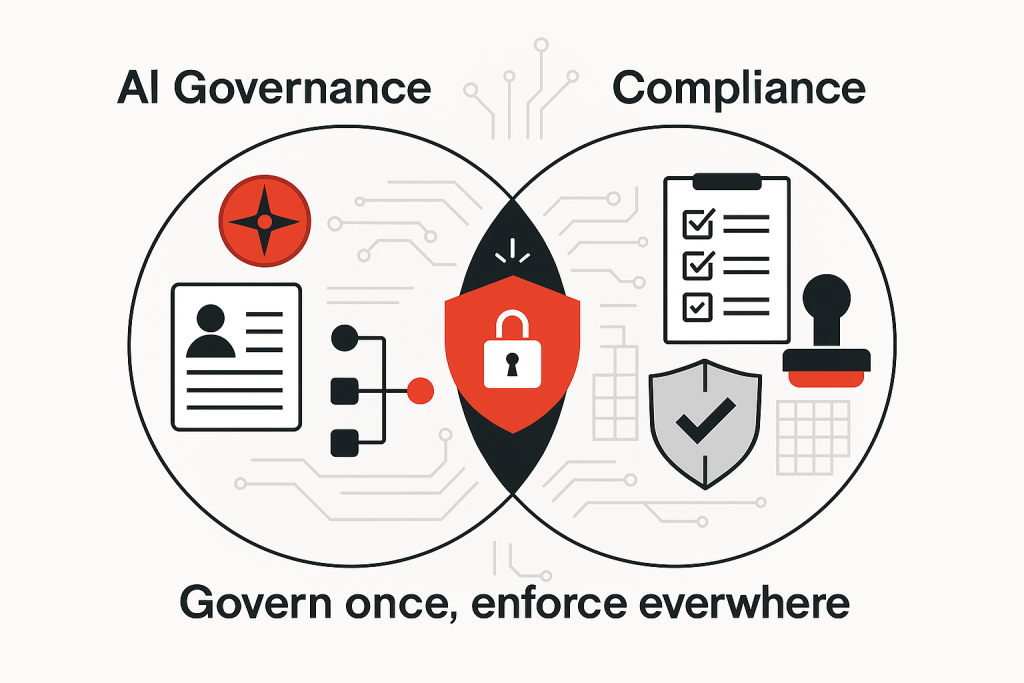
Where regulatory compliance fits
Compliance turns that fabric into evidence you can show—and reuses artifacts you already generate during development and operations.
Map governance → frameworks
- Security & privacy controls: align to NIST SP 800-53/171, ISO 27001/27701, SOC 2, sector rules (e.g., HIPAA, CJIS, GLBA).
- AI-specific overlays: integrate threat-modeling, evaluation gates, model/agent access reviews, and runtime monitoring as discrete controls in your matrix.
- Crosswalk: one safeguard should satisfy multiple requirements (e.g., evaluation gate ↔ risk assessment + change control + quality assurance).
Documentation & artifact strategy
- System Security Plan (SSP) / Control Matrix: clear ownership, implementation details, and links to live evidence (tickets, pipelines, logs).
- Risk assessments & DPIA/PIA: show impact analysis, mitigations, and residual risk rationale.
- Runbooks & SLAs: incident steps, MTTR targets, escalation trees—risk, made predictable.
- Continuous monitoring: cadence for control health checks, KPI thresholds, exception handling.
Assurance & attestation
- Independent testing: penetration tests and control tests scoped for AI (prompt-injection scenarios, model endpoint hardening, agent privilege escalation).
- Third-party assessments/certifications: SOC 2 reports, ISO certificates, government assessments (e.g., FedRAMP paths where in scope).
- Evidence handling: immutable storage, chain of custody, reviewer notes—security you can audit.
Minimum viable compliance pack (fast start)
- AI policy + risk-tiering standard
- Model card template + last eval report
- Threat model + compensating controls
- Access review for models/agents
- IR playbook with AI kill-switch
- Control matrix mapped to NIST/ISO/SOC 2 with live links to logs/tickets
The win: fewer audit cycles, faster customer approvals, and high confidence at the board—audit-ready, always.
AI governance vs regulatory compliance side-by-side
| Topic | AI Governance (internal) | Regulatory Compliance (external) |
|---|---|---|
| Purpose | Build safe, effective AI | Prove conformance and accountability |
| Scope | Policies, roles, lifecycle controls, metrics | Laws, frameworks, audits, attestations |
| Evidence | Model cards, eval results, red-team reports, logs | SSPs, control matrices, test reports, auditor letters |
| Owner | Product, data science, security, risk | Compliance, legal, audit—validated by third parties |
| Cadence | Continuous, per release & runtime | Periodic (annual/quarterly) + continuous monitoring |
| Success | Trusted models; low incidents; fast recovery | Passed audits; reduced findings; customer trust |
Build one program that satisfies both
Govern once. Enforce everywhere. Practical blueprint:
- Inventory & risk tiering for all AI systems and agents.
- Control baseline that blends AI-specific safeguards with your existing security controls.
- Mapping layer to frameworks (e.g., NIST SP 800-53/171, ISO 27001, SOC 2) so one control produces many proofs.
- Policy-to-proof automation – generate artifacts and dashboards from the source of truth (tickets, pipelines, eval runs, logs).
- Runbooks + SLAs – clear ownership, incident steps, and measurable MTTR for AI issues.
- Continuous assurance – scheduled red-teaming, regression tests, and change-control gates before deployment.
Outcome: risk made predictable, audits simplified, and delivery speed preserved.
AI-specific controls most auditors will expect
- Documented intended use and prohibited uses
- Data handling rules for training, tuning, and prompts (PII handling, retention)
- Evaluation evidence: robustness, safety, bias, and security tests with pass criteria
- Access control for models and agents; segregation of duties
- Monitoring for model drift, abuse, leakage, and unauthorized changes
- Incident response: playbooks, kill-switches, and customer communication plans
Keep it simple: from policy to proof—tie each control to a stored artifact.
Metrics that matter
- Percentage of AI systems with assigned risk tier
- Evaluation coverage and pass rate per release
- Mean time to detect/respond to AI incidents
- Change lead time with security gates passed on first attempt
- Audit finding rate and time-to-remediate
These KPIs show both governance health and compliance readiness.
FAQ (plain English)
Is AI governance required by law?
Not universally. But regulators and customers increasingly expect evidence that you govern AI risks. Strong governance reduces findings when formal regulations apply.
Do ISO 27001 or SOC 2 cover AI?
They cover security and privacy foundations. Add AI-specific controls (threat modeling, evaluation, model/agent access) and map them into your control matrix.
What documents should we prepare first?
An AI policy, risk-tiering standard, model card template, evaluation plan, and incident playbook—then connect each to compliance artifacts.
Why CybertLabs
Compliance, decoded. Managed security under control. AI built to take a hit.
- Proven compliance leadership: Trusted advisor across U.S. federal programs since 2007—leading FISMA compliance on 150+ systems annually and guiding Cloud Readiness/FedRAMP reviews.
- Process efficiency at scale: Re-engineered RMF workflows and created data-gathering templates and boilerplates adopted by ~95% of systems, cutting effort by 25–50% while improving artifact quality.
- Hands-on assessments: NIST SP 800-53/171 control assessments, continuous monitoring programs, privacy impact documentation, and audit-ready SSPs for government agencies and private organizations.
- Policy → Proof automation: We operationalize frameworks (RMF/OSCAL/CARTA) so your pipelines generate the evidence auditors ask for—audit-ready, always.
- Secure-by-design AI: Threat modeling and red-teaming for models/agents, access controls for machine identities, and evaluation gates that let you ship trusted AI without slowing delivery.
Ignite change in your cyber mission—with audit-ready compliance, managed control, and AI you can trust.
NIST AI Risk Management Framework (AI RMF) – https://www.nist.gov/itl/ai-risk-management-framework
NIST SP 800-53 security controls – https://csrc.nist.gov/publications/sp
ISO/IEC 27001 overview – https://www.iso.org/standard/27001
AICPA SOC 2 Trust Services Criteria – https://www.aicpa.org/resources/article/trust-services-criteria
FedRAMP documentation – https://www.fedramp.gov/