
Table of Contents
What is AI Auditing?
AI auditing is the process of systematically evaluating artificial intelligence systems to ensure they operate securely, fairly, and in alignment with organizational policies and regulatory standards. While traditional IT audits examine network infrastructure, servers, and applications, AI auditing goes deeper by focusing on data inputs, algorithmic decision-making, governance structures, and the ethical implications of automated outcomes.
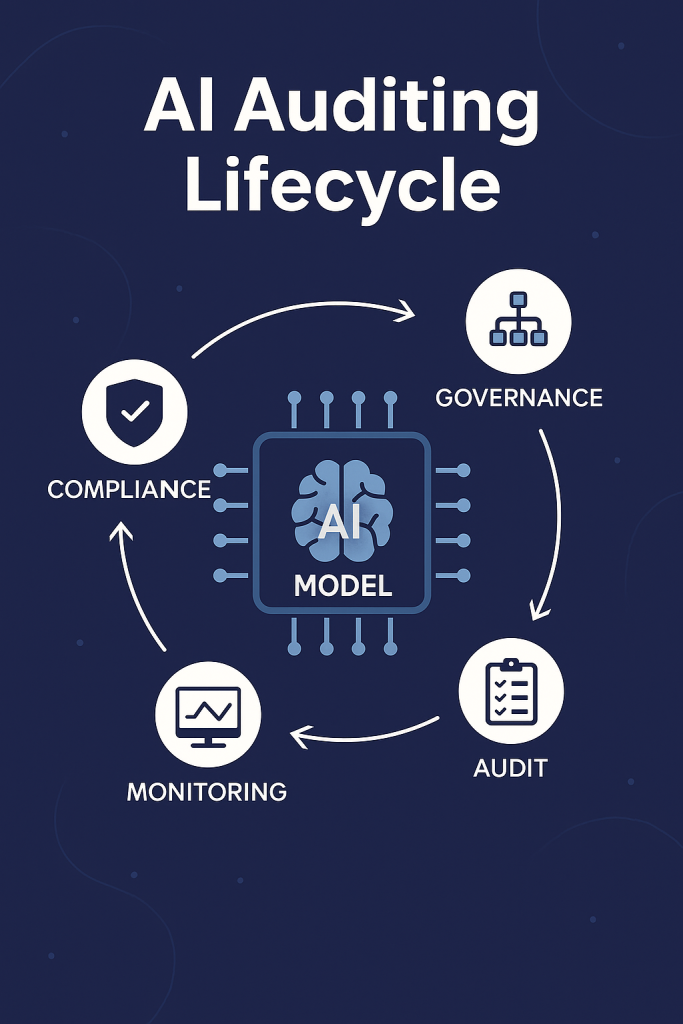
Properly reviewing AI involves looking at the full lifecycle of a system: how it is trained, how it makes decisions, how outputs are validated, and how updates are managed over time. This process not only identifies technical flaws but also highlights compliance risks such as data privacy violations or bias in decision-making. By applying principles of AI governance, organizations can ensure that their AI systems remain transparent, explainable, and accountable to both regulators and end users.
Without proper auditing, AI can function as a black box, producing outputs that influence hiring, healthcare, finance, and even legal processes without oversight. For this reason, reviewing AI systems are a cornerstone of modern AI risk management, helping businesses reduce uncertainty while improving the reliability of their AI systems.
Why is AI Auditing Important?
The importance of AI auditing lies in the growing reliance on AI systems to handle sensitive data and critical decisions. In sectors such as finance, healthcare, and small business cybersecurity, AI models are now embedded in processes that directly impact human lives and business outcomes. Without structured oversight, these models could make flawed or biased decisions, leading to legal penalties, reputational harm, or compliance risks.
Assessing AI is also critical because AI adoption often outpaces regulation. Governments are beginning to set expectations through frameworks like the EU AI Act or the NIST AI Risk Management Framework, but most organizations are already deploying AI tools without formal guardrails. By prioritizing AI governance and auditing practices early, businesses can stay ahead of regulators and demonstrate accountability to customers and stakeholders.
From a security perspective, AI review also helps identify vulnerabilities such as adversarial manipulation or data poisoning, where attackers deliberately feed bad data to distort model performance. Left unchecked, these risks can undermine trust in AI systems. By combining governance, auditing, and AI risk management, organizations gain confidence that their AI is not only effective but also resilient against emerging threats.
What are the Challenges in AI Auditing?
One of the biggest challenges in AI auditing is the lack of transparency in how models generate outputs. Many AI systems function as “black boxes,” making it difficult for auditors to explain why certain decisions were made. This lack of explainability is a serious concern for industries facing compliance risks, because regulators often require organizations to demonstrate that automated processes are fair and non-discriminatory.
Another challenge is the rise of shadow AI, where employees adopt AI tools such as ChatGPT, Copilot, or Jasper without formal approval from IT or compliance teams. This behavior introduces compliance risks because sensitive data may be processed outside approved systems. In small business cybersecurity, shadow AI can quickly grow into a hidden problem, exposing organizations to vulnerabilities they cannot see or control.
Finally, the rapid pace of AI development outstrips the maturity of current auditing frameworks. While AI governance is beginning to take shape, most businesses must adapt existing IT audit methods to AI systems, which often creates gaps. For example, traditional audits might verify software patching schedules but overlook how an AI model’s training data is stored or whether it is free of bias. These unique challenges make AI risk management an ongoing process that requires agility, technical expertise, and collaboration between IT, compliance, and data science teams.
Which Frameworks Support AI Auditing?
The process of reviewing AI does not yet have a universally accepted standard, but several emerging frameworks provide structure. The NIST AI Risk Management Framework (AI RMF) is one of the most influential, offering guidance on identifying, measuring, and managing AI risks throughout the lifecycle of a system. This framework encourages organizations to embed AI governance into their operations rather than treating audits as one-time events.
International standards are also being developed. The ISO/IEC 42001 standard focuses on establishing an AI management system that aligns with organizational policies, while the EU AI Act sets strict rules for high-risk AI applications in Europe, including requirements for transparency, human oversight, and compliance reporting. By aligning AI review with these standards, organizations can demonstrate accountability and reduce compliance risks.
In addition to these AI-specific frameworks, businesses can leverage existing IT audit structures such as NIST 800-53, SOC 2, or FedRAMP. These frameworks emphasize governance, monitoring, and reporting, which are directly applicable to AI systems. When combined, these approaches create a layered AI risk management model that strengthens both security and compliance.
What are Best Practices for Auditing AI Systems?
Effective AI reviewing requires a mix of technical checks, governance structures, and cultural change. The first best practice is to maintain a complete inventory of AI systems, including sanctioned tools and shadow AI discovered within the organization. Without a full picture, it is impossible to manage compliance risks.
Second, organizations must establish clear AI governance roles. Accountability should be assigned for model development, deployment, monitoring, and retirement. This includes documenting ownership of training data, versioning of models, and records of decision-making processes.
Third, audits should include technical evaluations such as adversarial testing, bias detection, and stress-testing AI systems against real-world scenarios. Regular testing ensures that AI models remain resilient against attacks and continue to meet performance expectations. Fourth, monitoring data pipelines is essential to confirm that data used for training and operations complies with privacy regulations.
Finally, automation can strengthen auditing by flagging anomalies in real time. Tools that integrate with existing IT monitoring systems can provide early warnings of compliance risks or security vulnerabilities. When combined with strong AI risk management practices, these best practices reduce uncertainty and build trust in AI systems.
What is the Role of Cybersecurity Teams in AI Auditing?
Cybersecurity teams play a critical role in extending traditional audits to cover AI. They are uniquely positioned to evaluate technical controls, monitor compliance risks, and enforce governance policies across the organization. Their responsibilities among AI include expanding risk assessments to include AI pipelines, collaborating with data science teams to review models, and training employees on the dangers of shadow AI.
For small business cybersecurity teams, this role can be especially important. Many small organizations lack dedicated AI experts, which means cybersecurity staff often serve as the first line of defense. By applying principles of AI governance, cybersecurity teams can integrate AI review into broader IT assessments, ensuring that AI is managed like any other critical system.
Cybersecurity professionals also serve as educators within their organizations. By raising awareness of compliance risks, they help employees understand why AI risk management matters and how to safely adopt AI tools. Ultimately, cybersecurity teams ensure that AI systems are not just secure but also trustworthy, ethical, and aligned with business objectives.
Conclusion
AI is no longer an experimental technology. It is deeply embedded in small business cybersecurity, healthcare, finance, and government systems. As reliance on AI grows, so does the need for structured AI auditing practices. By embedding AI governance, monitoring compliance risks, and managing shadow AI, organizations can transform AI from a potential liability into a driver of innovation.
Auditing AI systems is not about slowing progress but about ensuring innovation is sustainable, ethical, and secure. With the right mix of governance, oversight, and AI risk management, businesses can reduce uncertainty, protect against emerging threats, and build long-term trust in their AI initiatives. Learn more with CybertLabs.