
Table of Contents
Introduction: Preparing for a Quantum Future
Quantum cybersecurity is no longer a futuristic concept; it’s rapidly becoming a near-term reality. While its unprecedented computational power offers opportunities in research, AI, and optimization, it also introduces significant risks, particularly for cybersecurity and supply chain resilience. As the technology matures, organizations must begin proactively preparing for a world where traditional encryption methods may no longer be sufficient. This article explores how quantum computing impacts cybersecurity and supply chains, and provides strategic guidance for companies seeking to build post-quantum resilience.
Opportunities of Quantum Computing for Third-Party Risk Management
Enhanced Risk Modeling and Forecasting
Quantum computing enables high-speed processing of complex simulations and modeling that would take classical computers years to compute. For supply chain and third-party risk managers, this opens new possibilities in forecasting disruptions, simulating cascading failures, and stress-testing vendor resilience.
Real-Time Threat Detection
The advanced computational power of quantum systems allows for near-instantaneous analysis of massive datasets. This can enable real-time threat detection and anomaly monitoring across multi-tiered vendor networks—improving visibility into the health and security of supply chains like never before.
Quantum-Enhanced Encryption
Quantum Key Distribution (QKD) and Post-Quantum Cryptography (PQC) are two rapidly advancing solutions designed to protect sensitive data even in the face of future quantum attacks. Implementing these tools across third-party communications and vendor portals can provide long-term data confidentiality.
Improved Vendor Profiling
With faster data analysis, quantum computing can enhance vendor risk profiling by identifying weak points and trends hidden in historical performance, compliance audits, and threat data. This makes it easier to prioritize remediation and vendor re-assessment.
Quantum Cybersecurity Risks in Supply Chains and Third-Party Vendors
Encryption Breakdowns
Quantum computers have the potential to render widely adopted encryption protocols ineffective. RSA and ECC—the backbone of secure communications, digital signatures, and VPNs—can be broken in seconds with sufficient quantum power. This puts passwords, transactions, and sensitive communications at serious risk.
Public Key Infrastructure (PKI) at Risk
The stability of PKI, which enables everything from secure web browsing to authenticated email and identity verification, could crumble under quantum attacks. Without timely upgrades to post-quantum cryptography, organizations may experience cascading failures in digital trust, including unauthorized access, fraud, and operational disruption.
“Harvest Now, Decrypt Later” Attacks
Threat actors are already preparing for the quantum future by stealing encrypted data today, intending to decrypt it later once quantum computing capabilities mature. This puts long-life data—such as intellectual property, medical records, strategic plans, and customer data—at immediate risk, even if current encryption holds up for now.
Increased Blockchain Vulnerabilities
Quantum computing poses a unique threat to blockchain systems due to their reliance on asymmetric cryptography. Cryptocurrencies, supply chain ledgers, and smart contracts could all be compromised, potentially eroding trust in decentralized systems and undermining entire blockchain-based ecosystems.
Expanded Attack Surface
As quantum technologies are gradually integrated into commercial tools, they increase the number of potential cyberattack vectors. Each quantum-enabled third-party service provider or vendor introduces new pathways for exploitation, particularly if their quantum tools aren’t properly secured or assessed.
Quantum Supply Chain Dependencies and Risks
Although full-scale, commercially available quantum computing may still be years away, early quantum systems are already being developed and accessed via major cloud platforms. This reality introduces a wide range of third-party supply chain risks that companies must manage today.
Complex Hardware Supply Chains
Quantum hardware depends on rare and extremely precise components—like superconducting cables, cryogenic systems, and rare gases—often manufactured by a small number of suppliers. These limited sources create chokepoints and potential single points of failure, magnifying operational and supply chain risks.
Specialized Software and Research Partnerships
Development in the quantum field is highly collaborative. From cloud infrastructure providers to quantum simulation frameworks, cryptographic toolkits, and machine learning integrations—each external partner or software platform represents a potential vulnerability that must be managed through vendor risk assessments.
Uncertainty in Output and Transparency
Quantum systems often produce outputs that defy classical interpretation. Like AI, their results can be difficult to audit, trace, or reproduce. This lack of transparency complicates compliance with cybersecurity frameworks, makes validation difficult, and increases the risk of undetected errors or misconfigurations.
Regulatory Lag and Compliance Gaps
Technology innovation continues to outpace governance. Many organizations exploring quantum solutions may encounter a lack of industry standards (WEF Quantum Governance) or regulatory guidance, increasing the likelihood of mismatched security expectations between third parties. Establishing contracts with explicit quantum-readiness requirements will be essential.
To proactively secure your third-party quantum ecosystem, learn more at CybertLabs.
Make your Organization Quantum Cybersecurity Ready
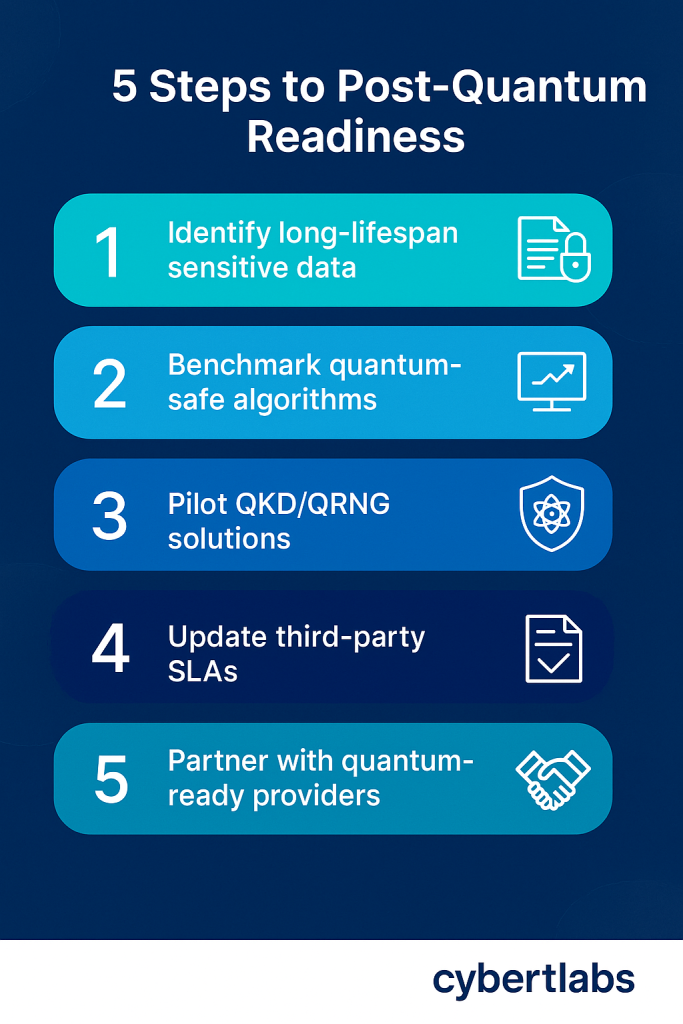
Getting ahead of quantum risk doesn’t require a crystal ball—it requires a practical strategy. Below are five key steps to help your organization begin its post-quantum transformation:
- Identify sensitive data with long confidentiality lifespans. Prioritize intellectual property, customer data, and critical internal records that must remain protected for years to come.
- Evaluate quantum-resistant cryptographic algorithms. Start benchmarking PQC standards such as lattice-based or multivariate polynomial schemes endorsed by NIST.
- Integrate quantum key technologies. Begin phased implementation of Quantum Key Distribution (QKD) and Quantum Random Number Generators (QRNG) in high-security use cases.
- Upgrade critical systems and vendor contracts. Include post-quantum requirements in procurement language and vendor SLAs.
- Collaborate with quantum-ready solution providers. Work with partners already building quantum-resilient infrastructure to reduce technical friction and speed up deployment.
Conclusion: Future-Proofing Begins Now
Quantum computing promises to reshape every facet of digital operations—from data protection and AI to logistics and risk modeling. While the opportunities are immense, so are the risks. Waiting for quantum maturity to arrive before acting is no longer an option.
Forward-thinking organizations must begin post-quantum preparation today by adapting third-party risk strategies, exploring PQC adoption, and auditing supply chains for quantum exposure.
At CybertLabs, we help enterprises identify quantum risks and modernize their cybersecurity programs to stay ahead of the threat curve. Explore our Quantum Security Services to begin building a safer, more resilient future.