
AI-powered Zero Trust is more than just a security buzzword — it’s become a guiding principle for modern cybersecurity. The concept of “never trust, always verify” helps protect organizations in a world where traditional perimeters no longer exist. But as threat actors grow more sophisticated and environments become more complex, Zero Trust alone may not be enough. That’s where Artificial Intelligence (AI) steps in.
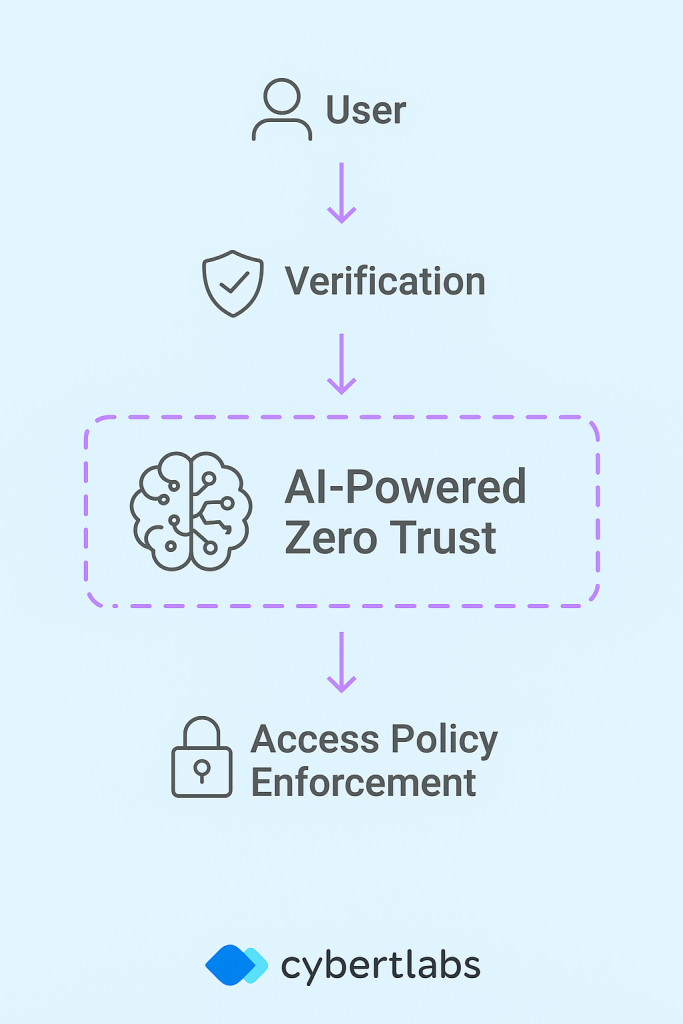
By combining AI with Zero Trust, organizations can build stronger, faster, and more adaptive security architectures. Let’s explore how.
AI-Powered Zero Trust: A Natural Fit
Zero Trust requires granular, continuous verification of users, devices, applications, and data. That means massive volumes of security events to monitor — far too much for humans alone.
AI bridges that gap by:
✅ Continuously analyzing user and device behavior
✅ Detecting anomalies in real time
✅ Automating risk-based decisions
In this way, AI provides the speed, scalability, and contextual awareness needed to make Zero Trust work at enterprise scale.
Adaptive Authentication with Machine Learning
Traditional security controls often rely on static rules: if a login comes from an unusual location, flag it. But attackers can adapt to static rules.
Adaptive authentication uses AI to make these processes dynamic. By analyzing factors like device health, behavioral patterns, time of day, and geolocation, machine learning models can calculate risk scores on the fly.
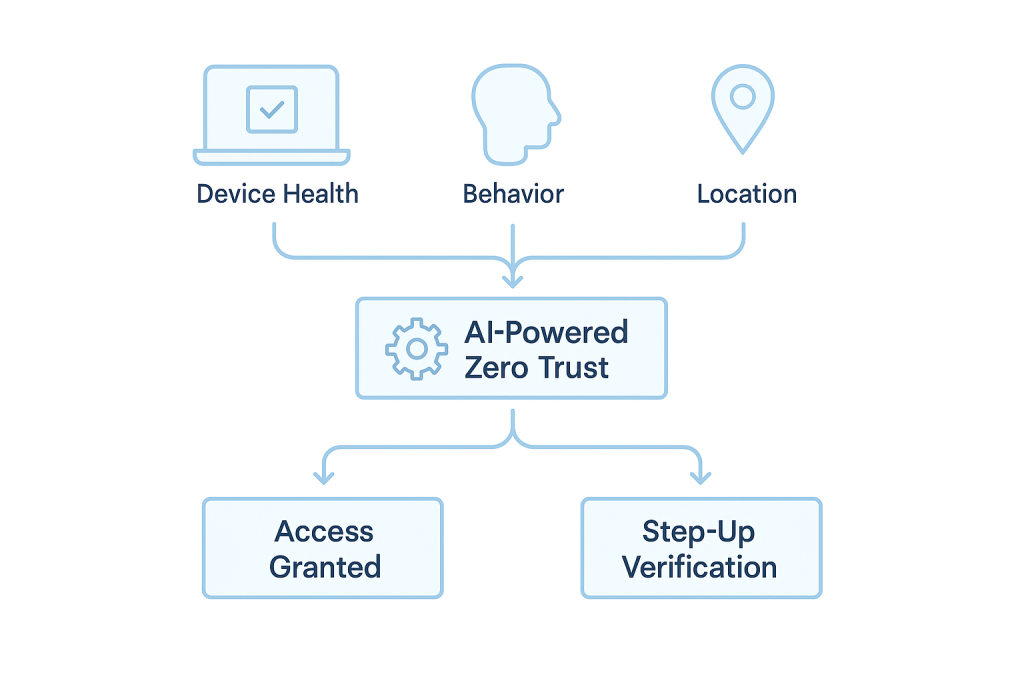
If a user is performing a high-risk action from an unfamiliar device, AI-driven systems can step up authentication — for example, requiring a one-time passcode or biometric scan. If behavior looks routine, the system can minimize user friction.
This kind of intelligent, risk-based authentication is a cornerstone of AI-enhanced Zero Trust.
Behavioral Biometrics and Continuous Trust
Another way AI strengthens Zero Trust is through behavioral biometrics. This technology analyzes how a person interacts with their device — typing speed, mouse movements, touchscreen patterns — and uses machine learning to build a behavioral profile.
If someone’s behavior suddenly changes, the system can take action: logging them out, forcing re-authentication, or alerting security teams.
Behavioral biometrics can run silently in the background, offering continuous identity verification without interrupting productivity. That means stronger security without sacrificing usability — a crucial goal in Zero Trust.
AI-Driven Threat Intelligence
Another powerful use of AI within Zero Trust is enriching threat intelligence. Traditional threat feeds can become outdated quickly or fail to detect subtle patterns of malicious behavior. AI-powered threat intelligence platforms, however, continuously analyze billions of data points from endpoints, cloud systems, and third-party sources to identify emerging threats in real time.
By automatically correlating these signals, AI systems can provide security teams with actionable insights — highlighting which assets are most at risk, what attack patterns are trending, and where to prioritize defensive resources. This proactive, data-driven threat intelligence supports Zero Trust by allowing organizations to adapt their policies to evolving attack techniques almost instantly.
Integrating AI with Security Operations Centers (SOC)
Finally, integrating AI into Security Operations Centers is a natural complement to Zero Trust. Many SOCs struggle with alert fatigue and staffing shortages, making it hard to maintain 24/7 vigilance. AI can help filter false positives, correlate security events, and prioritize high-risk incidents so that human analysts can focus on what really matters.
For Zero Trust to succeed, organizations need their SOCs to quickly spot and isolate suspicious behavior before it spreads. With AI-driven detection and response capabilities, security teams gain faster situational awareness and stronger containment, which reinforces the Zero Trust principle of limiting lateral movement and enforcing least privilege at all times.
Automating Zero Trust Operations
Zero Trust demands consistent policy enforcement and frequent updates to trust models. AI can automate these operational tasks, such as:
🔹 Classifying and segmenting devices dynamically
🔹 Adjusting access privileges based on real-time data
🔹 Updating security policies as new threats emerge
According to NIST’s Special Publication 800-207 on Zero Trust Architecture, organizations should continuously verify and enforce least-privilege policies to protect modern systems.
By automating these tasks with AI, organizations can maintain a dynamic Zero Trust posture, even as users, devices, and workloads change constantly.
Challenges to Consider
While AI strengthens Zero Trust, it also introduces new challenges. AI models can be manipulated by adversarial inputs, creating potential security blind spots. Security teams must be prepared to validate and monitor AI-driven systems to ensure they stay effective and fair.
Similarly, organizations must be transparent about how AI models make decisions, especially if those decisions affect user access or privacy. Explainability and accountability are critical.
Moving Forward
The future of cybersecurity will rely on AI-powered Zero Trust to deliver adaptive, resilient security. AI brings the speed and intelligence required to manage a Zero Trust environment in real time, while Zero Trust provides the framework to ensure only authorized, verified activities can take place.
Together, they help organizations adapt to today’s threat landscape while balancing security with usability.
At CybertLabs, we help clients integrate AI into their Zero Trust strategies, from adaptive authentication to continuous risk assessment. If you’re ready to modernize your security program, we’re here to help.
CybertLabs can help you plan and implement AI-powered Zero Trust. Contact us today!